Driving Sustainability with Thermoplastic Composites: How Toray PMC Is Shaping the Future of Green Materials
Across industries, the demand for sustainable materials is reshaping how products are designed and manufactured. Companies in automotive, aerospace, consumer electronics, and medical devices are looking beyond traditional materials and turning to thermoplastic composites for their recyclability, energy efficiency, and performance. These composites offer a way to reduce environmental impact without compromising strength and durability, making them a cornerstone of future manufacturing.
As the industry moves in this direction, Toray Performance Materials Corporation (Toray PMC) is helping lead the change with technologies that combine innovation, sustainability, and reliability. By developing solutions that reduce waste, conserve resources, and support circular practices, Toray PMC is redefining what composites can achieve.
Closing the Loop with Thermoplastic Composite Recycling
Recycled thermoplastic resins such as PET, polypropylene (PP), and polyamide (PA) are becoming essential in lowering the carbon footprint of manufacturing. They conserve resources, reduce waste, and fit into circular economy models.

Toray PMC has advanced this approach with its composite recycling program. By reusing internal scrap, the company creates composites with up to 20% recycled content while maintaining high mechanical performance. This method supports low-emission manufacturing and demonstrates how recycling can be integrated into large-scale production without sacrificing quality.
Harnessing the Power of Nature
Renewable fibers like flax, hemp, and coconut are gaining attention for their biodegradability and favorable strength-to-weight ratios. They provide an alternative to synthetic reinforcements and enable manufacturers to design products with lighter footprints both physically and environmentally.
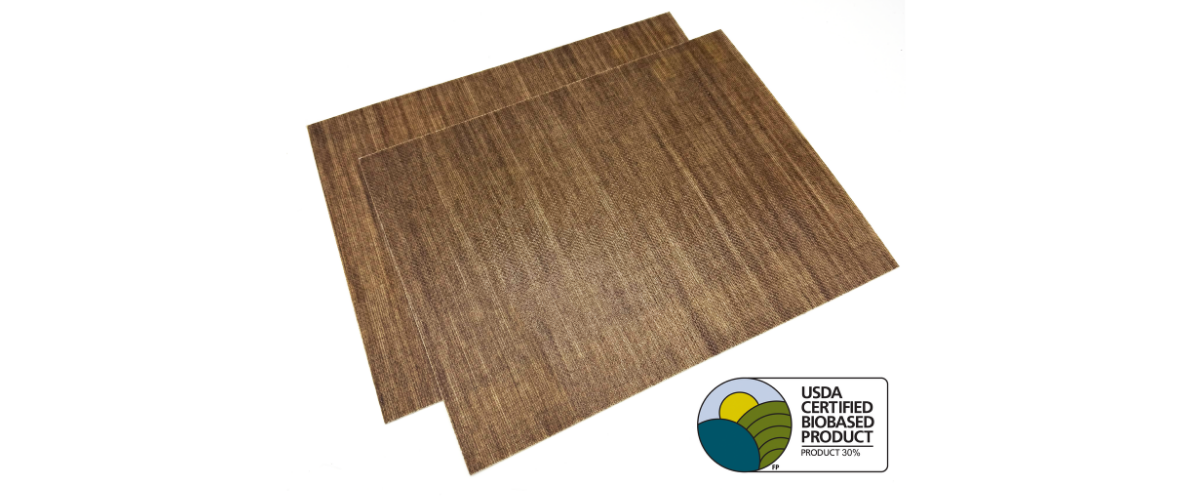
Toray PMC’s EcoTerra™ composite embodies this progress. By combining woven flax fabric with a biobased thermoplastic resin, EcoTerra™ delivers at least 30% biobased content and carries USDA certification. It reduces reliance on fossil-based materials while supporting lightweight, high-performance design.
A Cleaner Path Forward
Traditional thermoset resins and styrene-based composites present challenges for recyclability and environmental health because of irreversible curing and VOC emissions. Thermoplastic composites, by contrast, are fully recyclable and often manufactured without harmful solvents.
Toray PMC’s Envir-Bond® technology is a clear example. By eliminating the need for primers and adhesives, it allows direct injection of TPU, PU, and Pebax materials. This reduces VOC emissions and supports cleaner production practices, making it especially valuable in industries such as healthcare, sports, and consumer goods.
Building a Sustainable Future

- Net zero emissions by 2050 through lightweight product design, renewable energy adoption, and lifecycle emissions reduction
- Sustainable resource management by reducing fossil fuel dependency, recycling textiles and resins, and developing bioplastics
- Environmental restoration by minimizing water and air pollution, improving indoor air quality, and supporting education initiatives
- Healthier lives through medical material innovations that improve patient outcomes and reduce burdens on healthcare systems
These priorities align closely with global ESG objectives and reinforce Toray PMC’s role as a leader in sustainable material innovation.
The Future of Sustainable Manufacturing
The shift toward sustainable manufacturing is accelerating, and thermoplastic composites are positioned to play a central role. Their recyclability, versatility, and high performance make them the material of choice for industries seeking greener solutions.
With innovations such as the composite recycling program, EcoTerra™, and Envir-Bond®, Toray PMC is not only meeting this demand but also setting new benchmarks for environmentally responsible composites. For designers, engineers, and sustainability leaders, partnering with Toray PMC means access to advanced materials that support both performance requirements and environmental goals.
Related news